
How electron beam evaporation works
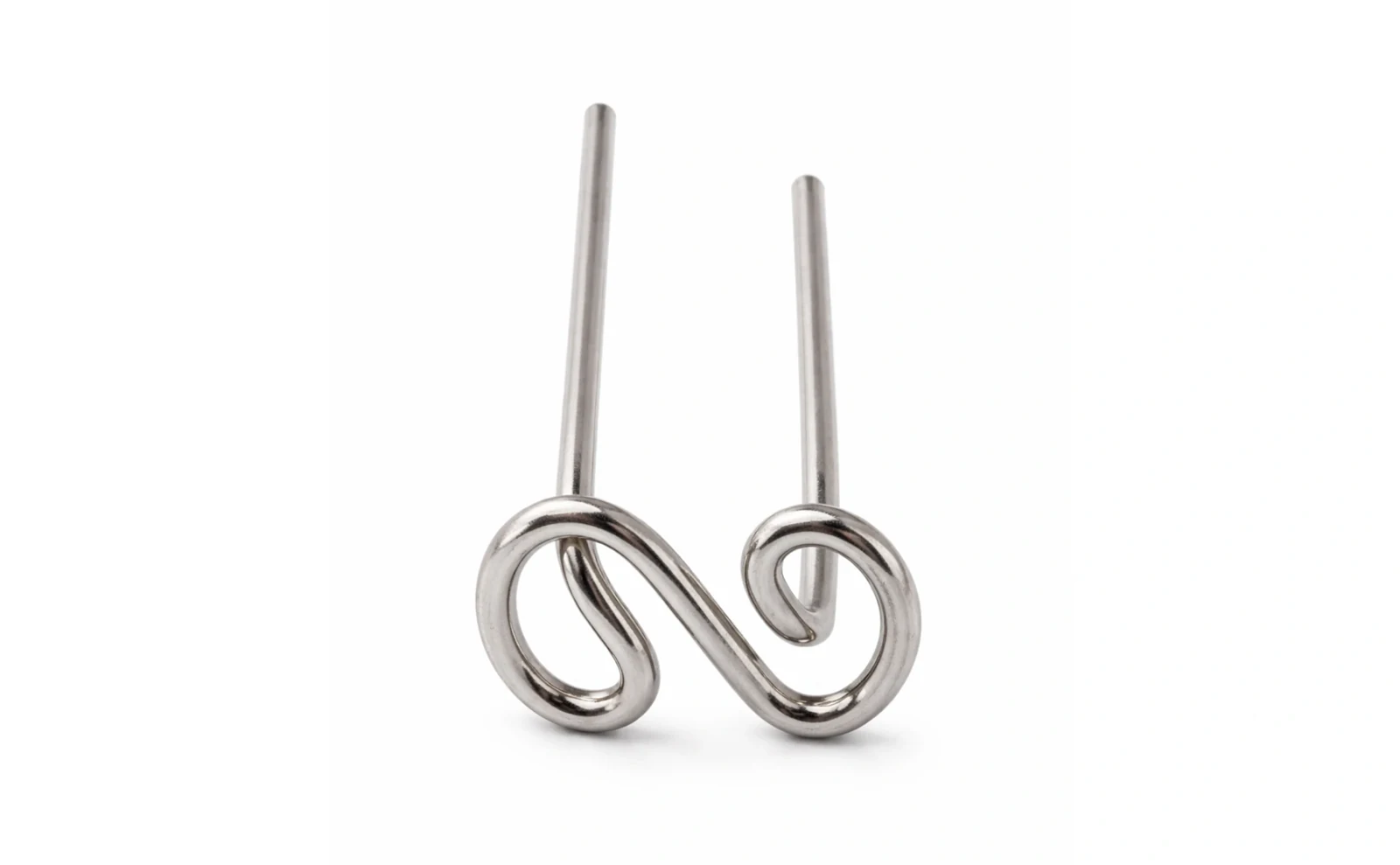
A heated tungsten filament emits electrons, which are accelerated through several kilovolts and bent through roughly 270° by a magnetic field onto the evaporant sitting in a water-cooled copper hearth. Bending the beam keeps the filament out of the vapour stream, so it is not coated by the material it is evaporating. The filament itself is a consumable — see tungsten filaments for e-beam guns.
The beam can heat a spot a few millimetres across to well above 2000 °C while the hearth stays near room temperature. Sweep coils move the spot across the charge to spread the heat and form an even melt pool. Useful deposition rates start once the vapour pressure at the pool reaches about 10⁻² mbar, which is why e-beam is the normal route for metals above roughly 1500 °C and for oxides.
Most production and research guns carry several pockets on a rotating or linear hearth, so one pumpdown can deposit an adhesion layer, a conductor and a cap without breaking vacuum. That is the main practical reason e-beam dominates multilayer metal stacks and optical coatings.
E-beam vs thermal evaporation
Thermal evaporation from a resistively heated boat is cheaper and simpler, and for aluminium, silver, gold and chromium in a research coater it is often the right answer. E-beam earns its extra cost when the material is too hot for a boat, when the boat would contaminate the film, or when rate control over many layers matters.
| Thermal (resistive boat) | Electron beam | |
|---|---|---|
| Practical source temperature | Up to roughly 1800 °C | Well above 2000 °C at the beam spot |
| Typical materials | Al, Ag, Au, Cr, Cu, In, Sn | Adds Ti, Ni, Co, refractory metals and oxides |
| Contamination from the source | Boat can alloy with the melt | Only the beam spot is hot; hearth is water-cooled |
| Rate control | Moderate | High, stable over long multilayer runs |
| Consumables | Boats — a limited number of runs with aluminium | Liners, filaments and the charge |
| Substrate exposure | Radiant heat | X-rays and stray electrons; shield sensitive devices |
For boat work, tungsten evaporation boats cover most of the thermal list. For a wider comparison that includes sputtering and CVD, see thin film deposition methods.
Pocket size and how full to load it
Pocket volume sets the charge size. Undersized pellets in a large pocket melt unevenly and leave voids the beam drills into; oversized pellets in a small pocket bridge and never form a proper pool. Match the piece size to the pocket first, then choose the form.
Fill the liner to roughly two-thirds to three-quarters of its depth. Too little and the beam spills onto the liner wall; too much and the melt creeps over the rim, bridges to the hearth and cracks the liner on cooling. Keep the fill level consistent between runs — the pool surface moves as the charge depletes, and rate calibration moves with it.
| Pocket volume | Pellet size | Shot | Note |
|---|---|---|---|
| About 2 cc | Ø6 mm | Ø2–6 mm | Shot packs densely and tops up precisely |
| 2–7 cc | Ø6–10 mm | Ø4–8 mm | Most multi-pocket research guns |
| 7–15 cc | Ø10–12 mm | Ø6–8 mm | Production pockets; slugs for long runs |
Choosing a crucible liner
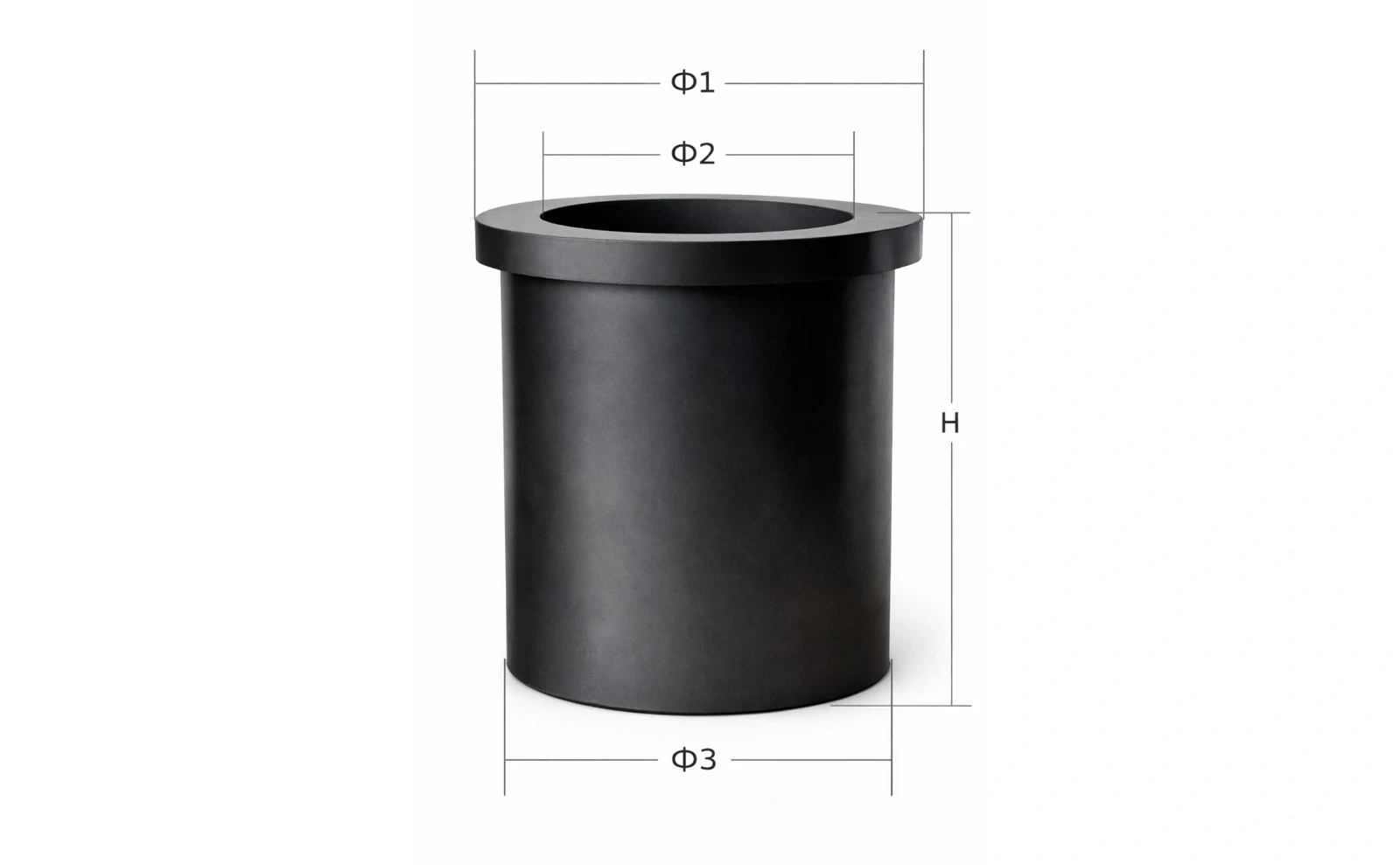
A liner sits between the melt and the copper hearth. It insulates the pool, so less beam power is lost to the cooling water, and it makes a pocket change a two-minute job instead of a hearth clean. The liner material has to tolerate the melt without dissolving into it.
| Liner | Suits | Watch for |
|---|---|---|
| Isostatic graphite | Cu, Au, Ag, Al and most non-carbide-forming metals | Carbon dissolves into Ti, Ni, Co, Fe and refractory metals |
| Boron nitride or BN composite | Aluminium, which wets and creeps out of other liners | Thermal shock — ramp power slowly |
| No liner (water-cooled Cu hearth) | Ti and reactive metals where purity matters most | More beam power for the same rate; the metal forms its own skull |
| Refractory metal or ceramic | Where carbon pick-up is unacceptable | Check the melt does not alloy with or wet the liner |
Graphite liners are machined from the same isostatic grades as our graphite crucibles — ultra-fine grain and purified to ≤5 ppm ash where the film must stay clean. Send the hearth drawing or a used liner and we match it.
Material by material: Al, Cu, Ti, Ni, Co and Cr
Each metal behaves differently under the beam. These are the settings and sources that work, and the problems that usually show up first.
| Material | Melts | Source | Watch for |
|---|---|---|---|
| Aluminium pellets | 660 °C | E-beam with BN or graphite liner; tungsten boat for thermal | Oxide skin causes spitting — pre-melt at low power with the shutter closed |
| Copper pellets | 1085 °C | E-beam pocket with graphite liner | Alloys with W and Mo boats; OFHC charge keeps oxygen out of the film |
| Titanium pellets | 1668 °C | E-beam only: graphite liner or bare water-cooled hearth | Getters oxygen; a graphite liner adds trace carbon |
| Nickel pellets | 1455 °C | E-beam pocket with liner | Ferromagnetic charge distorts the steering field — re-tune sweep and position |
| Cobalt shot | 1495 °C | E-beam pocket with liner | Also ferromagnetic; shot gives good thermal contact |
| Chromium shot | Sublimes ~1200 °C | E-beam, tungsten boat or baffled box | No melt pool forms — use a wide sweep to avoid drilling a hole |
Adhesion layers of titanium or chromium are normally 5–20 nm. Where a fab bans chromium, titanium does the same job under gold.
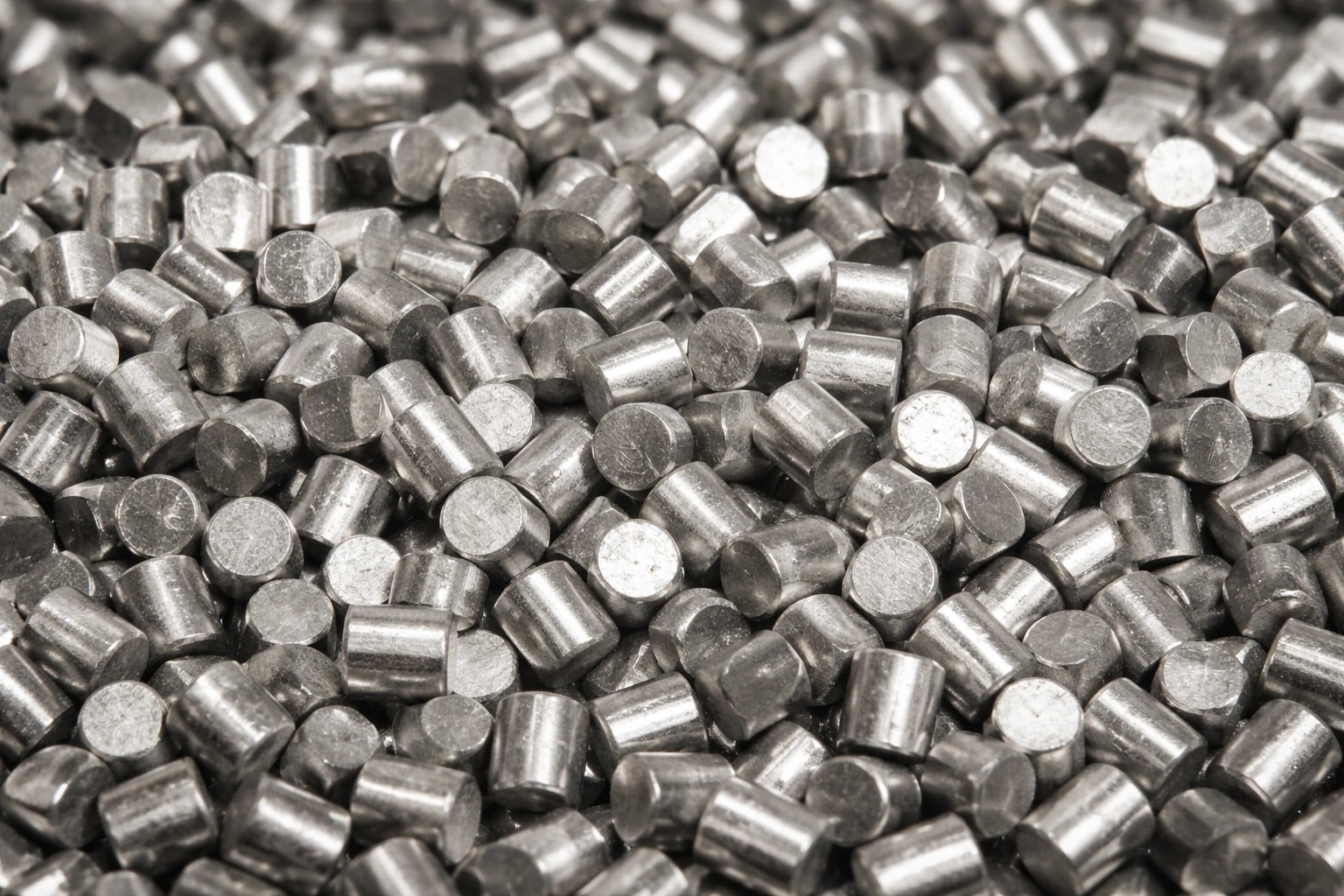
Pellets, shot, corn or slugs
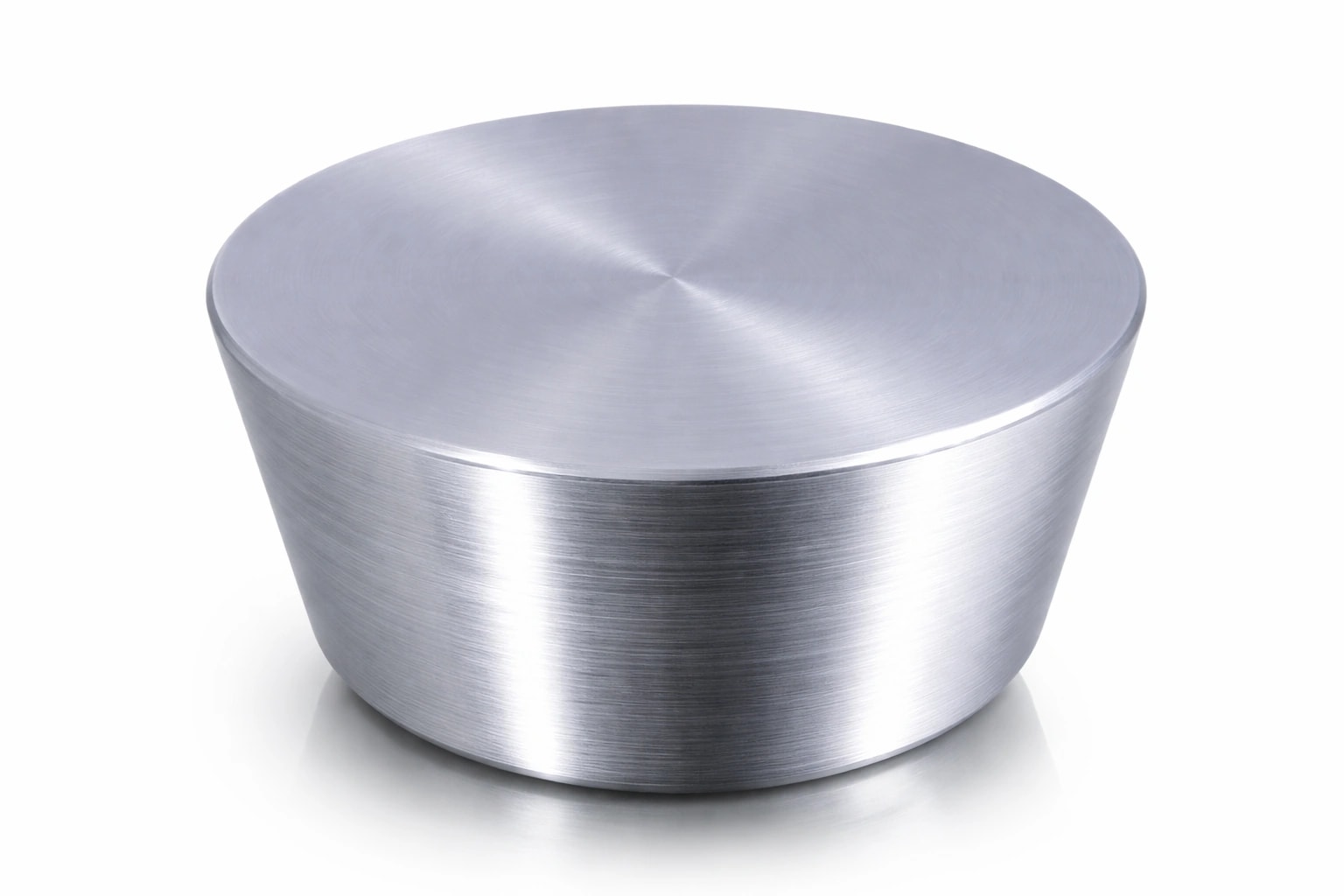
The form of the charge affects how evenly it melts and how easily you can top it up. For e-beam work the choice is usually between pellets and shot; corn belongs in box sources.
- Pellets and slugs — the general-purpose choice, sized to the pocket. Consistent mass makes weighed charges repeatable.
- Shot — packs densely, gives better thermal contact and melts evenly. Best for small pockets and topping up between runs.
- Chromium corn — coarser granules for baffled box sources and long runs where refilling is impractical.
- Wire — for wire-fed and filament sources in thermal systems rather than e-beam pockets.
The full range, with sizes and purities for each metal, is on the evaporation materials page.
What usually goes wrong
Most e-beam problems show up as spitting, rate drift or a cracked liner, and most trace back to the charge or the ramp rather than the gun.
- Spitting — oxide skins, trapped gas or a ramp that is too fast. Soak the charge at low power with the shutter closed until the pool is clean and still.
- Tunnelling — the beam drills a hole instead of forming a pool, common with poor thermal conductors and subliming metals. Widen the sweep.
- Cracked liners — thermal shock, overfilling, or melt that freezes and expands against the wall. Ramp up and down gradually and keep the fill level below the rim.
- Carbon in the film — a graphite liner under Ti, Ni or Co. Switch to a bare hearth or a different liner.
- Rate drift through a run — the pool surface falling as the charge depletes. Top up to the same level each time.
Frequently asked questions
What is electron beam evaporation?
A physical vapour deposition method in which a focused electron beam heats the source material in a water-cooled hearth until it evaporates, and the vapour condenses on the substrate. Because only the beam spot gets hot, it reaches temperatures resistance heating cannot, with less contamination from the crucible.
When should I use e-beam instead of thermal evaporation?
When the material evaporates above roughly 1500 °C, when a resistive boat would alloy with the melt, or when you need stable rate control across many layers. Titanium, nickel, cobalt and oxides are e-beam materials. Aluminium, silver and gold work well from a boat in most research coaters.
Do I need a crucible liner in an e-beam pocket?
Usually, yes. A liner insulates the melt from the water-cooled hearth, so less power is needed for the same rate, and it makes pocket changes quick. The exception is reactive metals such as titanium where the highest purity matters; they are often melted directly in the copper hearth, where they form their own skull.
How full should an e-beam liner be?
Roughly two-thirds to three-quarters of its depth. Underfilled liners let the beam hit the wall; overfilled liners let the melt creep over the rim and bridge to the hearth, which cracks the liner on cooling. Keeping the level consistent run to run also keeps the rate calibration valid.
Can I evaporate alloys by e-beam?
Only approximately. Each element leaves at a rate set by its own vapour pressure, so the film composition drifts as the charge depletes. A pre-alloyed charge reduces the drift but does not remove it. For tight composition control, co-evaporate from separate rate-controlled pockets or sputter from an alloy target.
Talk it through with an engineer
If this guide has not answered your question, describe your process and we will tell you what we would specify — including when the answer is that you do not need what you were about to buy.
Drawings, STEP files and photographs can be attached to the form. Prefer to talk it through? Leave a phone number and ask for a call.
What to include
- Your deposition process and tool
- Film requirement or the problem you are solving
- Volumes, if you know them
No drawing? Send photographs of the worn part — we can work from that.